
Blackberry lilly
Blackberry lilly
Happy Green Shop
Country of origin: United Kingdom
Couldn't load pickup availability
20 Seeds
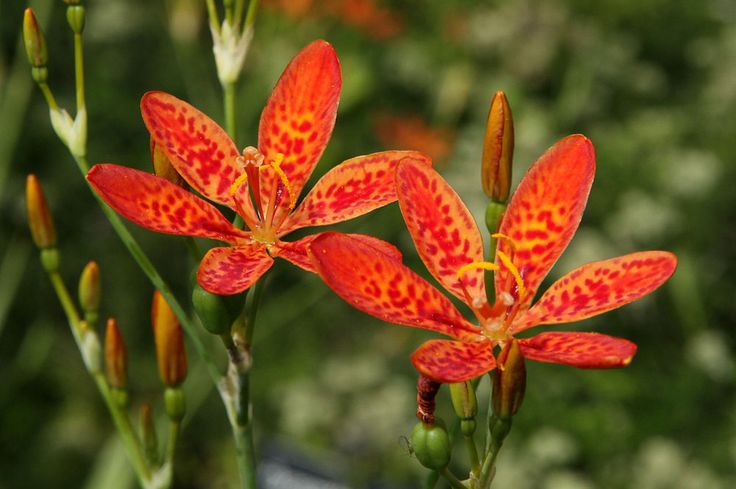
Blackberry Lily is an attractive perennial related to iris, rather than a true lily. It has upright, sword-like green leaves and produces attractive orange to reddish-orange flowers marked with dark red spots. After flowering, the seed pods split open to reveal clusters of glossy black seeds that resemble blackberries, giving the plant its common name.
The plant can reach approximately 50–100 cm in height and is suitable for flower borders, containers, naturalistic planting and mass planting. It prefers sun and well-drained soil and becomes reasonably drought tolerant once established.
🌱 Best Planting Time in the Gulf
Blackberry Lily is warm-tolerant and can be grown in Gulf conditions, but young seedlings should be protected from extreme summer heat.
- Kuwait: October–November and February–March
- UAE, Qatar and Bahrain: October–March
- Saudi Arabia and Oman: October–March, depending on the local climate
- In very hot areas, start the seeds in containers where you can control heat and moisture.
Autumn sowing can also be useful because natural seasonal temperature changes can help with germination.
🌿 How to Sow the Seeds
Blackberry Lily is considered relatively easy to grow from seed. Importantly, some sources report that no special treatment is necessary, while other growers recommend a short period of cold stratification to improve or synchronize germination.
For Gulf conditions, I recommend the simpler approach first:
- Fill seed trays or small pots with a fine, fertile and well-drained seed-starting mix.
- Moisten the soil before sowing.
- Sow the seeds about 0.5–0.6 cm deep.
- Cover lightly with fine soil and gently firm the surface.
- Keep the soil evenly moist, but never waterlogged.
- A germination temperature around 21–22°C is suitable.
- Germination may occur in approximately 15–25 days, although some seeds can take longer.
- Keep seedlings in bright light, protected from intense Gulf afternoon sun.
- Once seedlings have several true leaves and a good root system, transplant them carefully.
❄️ Optional Cold Treatment
If germination is poor or irregular, you can try cold-moist stratification before sowing.
Place the seeds in a slightly moist medium in a sealed bag and refrigerate them for approximately 2–4 weeks, then sow them at warm temperatures.
However, this treatment is optional rather than essential, because Iowa State Extension specifically lists Blackberry Lily as requiring no pretreatment.
🌱 Transplanting
When the seedlings are well established:
- Spacing: approximately 30–45 cm
- Plant in a sunny or lightly shaded position.
- Choose a location with excellent drainage.
- Avoid planting where irrigation water accumulates.
- Transplant carefully to minimize root disturbance.
For landscape planting, wider spacing can be used when creating a naturalized or mass planting.
☀️ Sunlight
Blackberry Lily grows well in full sun to partial shade.
For the Gulf:
- Give plants plenty of morning sun.
- Light afternoon shade is helpful during periods of extreme heat.
- Avoid placing young seedlings against heat-reflecting walls or on very hot concrete.
Full sun generally produces the strongest flowering, while partial shade can help reduce heat stress in very hot locations.
💧 Watering
Keep newly sown seeds and young seedlings evenly moist.
After establishment:
- Water deeply when the upper soil begins to dry.
- Maintain moderate moisture during active growth.
- Allow excess water to drain freely.
- Avoid constantly wet soil.
Blackberry Lily is moderately drought tolerant once established, but excessive dryness during the hottest Gulf periods can cause leaf scorch and reduce flowering.
🌱 Soil
Use fertile or moderately fertile soil with excellent drainage.
A good Gulf planting mixture can contain:
- Sandy loam or quality garden soil
- Well-rotted compost
- Perlite, pumice or coarse sand
The plant can tolerate loam, sand and even clay provided drainage is adequate. Wet soil around the crown and rhizomes should be avoided because it can encourage rot.
🌿 Fertilizing
Apply a moderate amount of balanced fertilizer during active growth.
Avoid excessive nitrogen, which can encourage lush foliage without necessarily improving flowering.
A small amount of compost at the beginning of the growing season is also beneficial.
🌸 Flowering
The flowers are typically orange to reddish-orange with dark red spotting and are produced on upright stems above the foliage. Flowering can continue for several weeks under suitable conditions.
Plants grown from seed may flower in their first season if started early and given a long enough growing period, although flowering from seed is not guaranteed in the first year.
🖤 Decorative Seed Pods
One of the most attractive features comes after flowering.
The green seed pods dry and split open to reveal clusters of shiny black seeds that look remarkably like blackberries. The seed heads can remain decorative on the plant and can also be used in dried arrangements.
🪴 Growing in Containers
Blackberry Lily grows well in containers.
- Choose a deep container with good drainage.
- Use fertile but well-drained potting soil.
- Avoid leaving the pot standing in water.
- Place the container in morning sun with some afternoon protection during extreme Gulf heat.
- Containers also make it easier to move young plants away from excessive summer heat.
🔥 Gulf Climate Tips
- Start seeds during the milder Gulf growing season.
- Protect young seedlings from extreme afternoon heat.
- Excellent drainage is essential.
- Do not keep the soil permanently wet.
- Provide regular moisture while plants are actively growing.
- Established plants tolerate periods of dryness better than young seedlings.
- Containers are useful in very hot locations because they allow easier heat management.
- Remove spent flower stalks if you do not want the plant to self-seed.
🌱 Growing Tip: For Gulf gardeners, sowing in autumn is worth considering because the natural change in temperature can help the seeds germinate over the cooler season. If you prefer more control, start them in containers around 21–22°C and keep the seed mix evenly moist.
⚠️ Safety: Iris domestica is listed as potentially harmful if eaten, so keep seeds and plant material away from children and pets.
Share